
How to Tell If Your Mobile App Needs a Dev Shop or a Product Engineering Team
Choosing the right development partner is one of the most important decisions you’ll make when building a mobile app.
When you request project quotes, you’ll often notice one proposal is much cheaper than the others. The team responds quickly, promises a fast start, and seems like the easiest option.
That lower price can be tempting.
However, the difference in cost usually reflects a difference in what you’re actually buying.
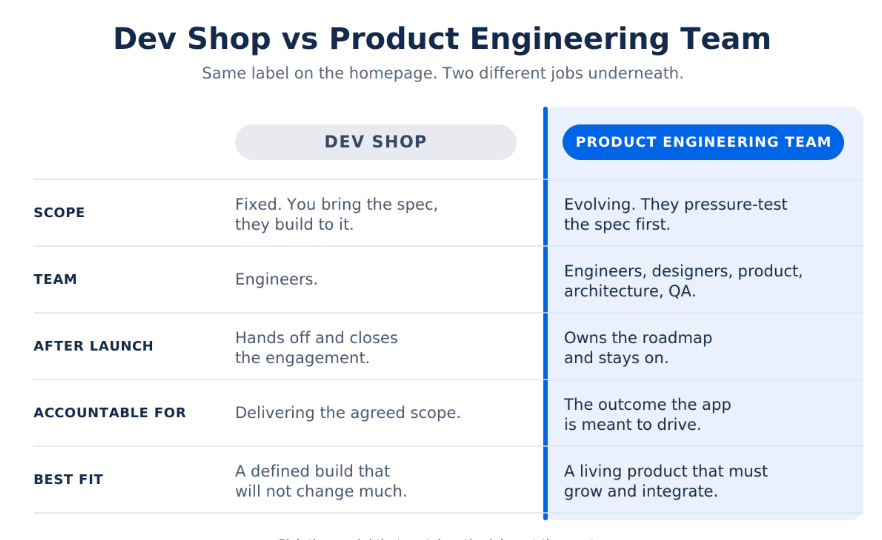
A development shop focuses on building the app you’ve already planned.
A product engineering team looks beyond the initial build. They think about how the app will grow, scale, integrate with other systems, and stay reliable over the next several years.
Both approaches have value.
The key is choosing the one that matches your business goals.
Many companies searching for custom mobile application development services discover that providers offer similar-looking services. The challenge is understanding which partner is best suited for your project before comparing prices.
What Does a Dev Shop Do?
A development shop works with a clearly defined scope.
You provide the requirements, and they focus on delivering the finished application.
Their process is usually straightforward:
- Review the project requirements
- Estimate development time
- Build the application
- Test the product
- Deliver the final app
This model works well when the project has stable requirements and is unlikely to change after launch.
A Dev Shop Is a Good Choice For
- Internal business applications
- Simple customer apps
- Event or trade show applications
- Minimum Viable Products (MVPs) with fixed features
- Short-term projects
In these situations, you’re paying for efficient execution rather than long-term product planning.
One thing you’ll often notice is that development shops talk about what they built rather than what happened after launch.
Their responsibility usually ends when the project is delivered.
What Does a Product Engineering Team Do?
A product engineering team approaches the project differently.
Instead of immediately estimating the work, they first ask important questions, such as:
- Who will use the app?
- What business problem does it solve?
- How will it grow over time?
- Which systems must it connect with?
- How will future updates be managed?
The application is viewed as one stage in the product’s life rather than the final destination.
Because of this, the team usually includes specialists in multiple areas:
- Product management
- UI/UX design
- Software architecture
- Mobile development
- Quality assurance
- DevOps and release management
This collaborative approach prepares the product for future growth instead of focusing only on launch day.
Businesses investing in software product engineering services are not simply purchasing an application. They are building a product that can continue evolving as customer needs and business requirements change.
The same team that designs the architecture often remains involved after launch, making future improvements faster and more efficient.
Five Questions That Help You Choose
The right choice becomes much clearer when you answer a few practical questions.
1. Will the Project Requirements Change?
If every feature is already defined and unlikely to change, a development shop can usually deliver the project successfully.
If you expect customer feedback to shape future releases, a product engineering team is often the better option because they plan for continuous improvement.
2. Does the App Need to Connect With Other Systems?
Some applications operate independently.
Others must integrate with systems such as:
- ERP software
- CRM platforms
- Payment gateways
- Analytics platforms
- Inventory systems
The more integrations involved, the more valuable long-term planning becomes.
This is where experienced teams providing custom mobile application development services can help design an architecture that supports future integrations without major rebuilding.
3. Who Will Maintain the App After Launch?
Launching an app is only the beginning.
After release, someone must manage:
- Operating system updates
- Security patches
- Performance improvements
- New features
- Bug fixes
If your organization doesn’t already have a long-term maintenance strategy, you’re looking for an ongoing technology partner rather than a one-time development service.
4. Is This One App or the Start of a Product?
Some businesses only need one application.
Others plan to expand with:
- Additional mobile apps
- Web portals
- Customer dashboards
- Admin platforms
- Partner portals
If your app is the foundation of a larger product ecosystem, planning for future growth from the beginning can save significant time and money.
5. Do You Have Technical Leadership In-House?
If your company already has experienced:
- Product managers
- Technical architects
- Engineering leaders
A development shop can successfully execute their vision.
If not, a product engineering team provides strategic guidance alongside development.
How to Identify the Right Partner?
You can often tell the difference during the first few conversations.
Signs You’re Talking to a Dev Shop
A development shop usually:
- Focuses on implementation
- Prices your existing requirements
- Discusses timelines and delivery
- Measures success by completing the project
Signs You’re Talking to a Product Engineering Team
A product engineering partner typically:
- Challenges assumptions
- Asks detailed business questions
- Suggests improvements
- Discusses scalability
- Plans for long-term maintenance
Instead of simply asking what you want built, they also ask why you’re building it.
Their case studies also focus more on business outcomes than technical deliverables.
Examples include:
- Reduced customer onboarding time
- Faster product launches
- Higher user engagement
- Improved business efficiency
Why Choosing the Wrong Partner Becomes Expensive?
Neither model is inherently better.
Problems happen when the wrong partner is selected for the wrong project.
If you hire a development shop for a product that constantly evolves, you may experience:
- Difficult integrations
- Poor scalability
- Expensive future rebuilds
- Multiple vendors managing different parts of the product
The original low-cost proposal often becomes much more expensive over time.
The opposite is also true.
Hiring a full product engineering team for a simple application with fixed requirements may lead to unnecessary costs because you’re paying for expertise your project doesn’t require.
The goal is to match the service to the complexity of your product.
Which Option Is Right for You?
Choose a development shop if your project has:
- Fixed requirements
- Limited future changes
- A clear delivery date
- Simple technical needs
Choose a product engineering team if your application needs:
- Continuous development
- Long-term maintenance
- Complex integrations
- Product strategy
- Future scalability
Businesses investing in software product engineering services often gain a long-term technology partner that helps the product evolve instead of simply delivering the first version.
Conclusion
The decision isn’t about finding the cheapest quote or the largest development company.
It’s about understanding the type of project you’re building.
If your mobile app is a one-time project with stable requirements, a development shop may be the right choice.
If you’re building a product that will continue growing, integrating with other systems, and serving customers for years, working with a team that provides custom mobile application development services alongside long-term software product engineering services can deliver far greater value over the life of the product.
Choosing the right partner from the beginning helps you avoid costly rebuilds, supports future growth, and gives your product the foundation it needs to succeed.